
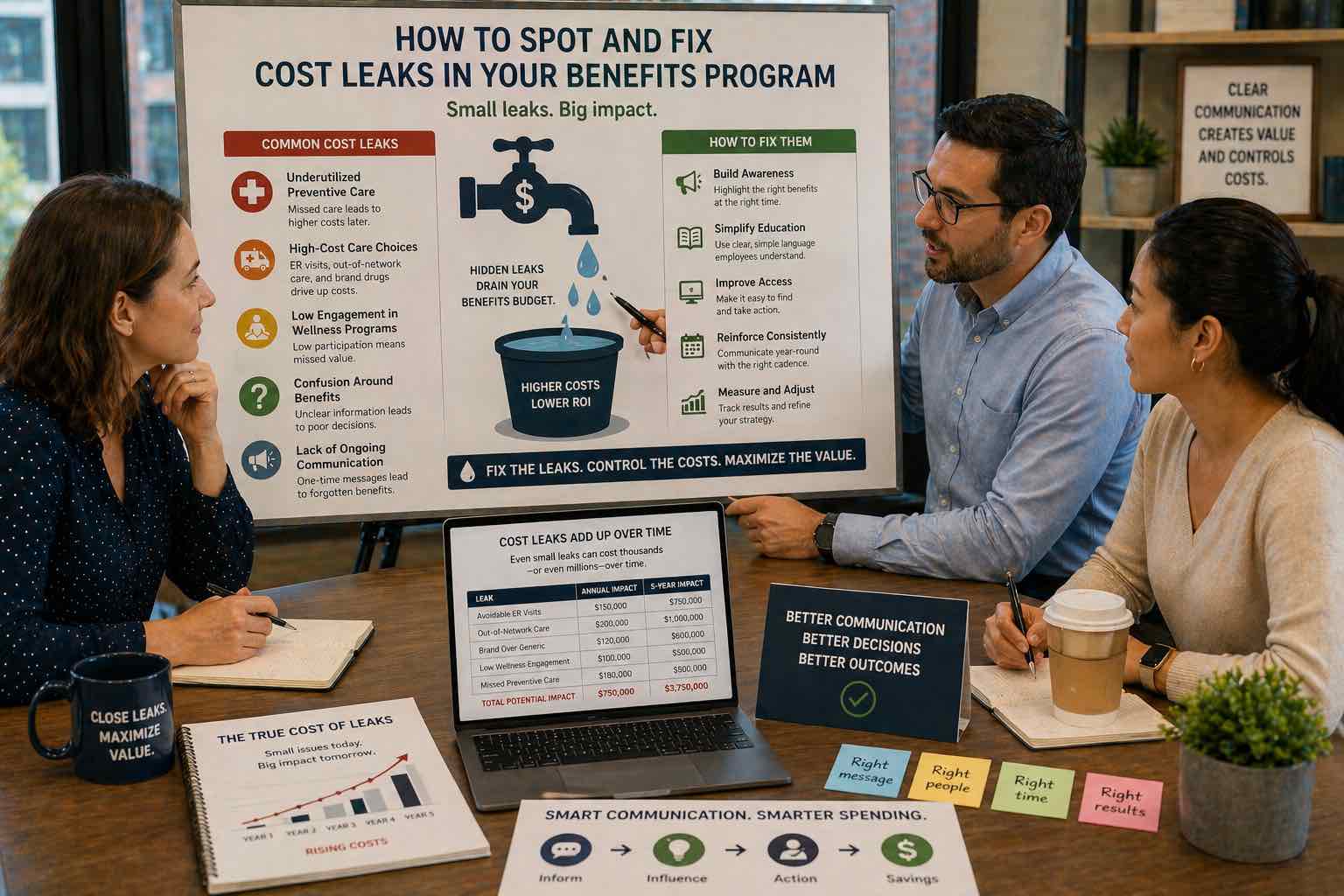
Most organizations don’t have a benefits problem—they have a visibility problem.
On the surface, benefits programs may look strong: competitive plans, wellness initiatives, and a range of resources designed to support employees. Yet costs continue to rise, utilization remains inconsistent, and leadership struggles to see clear ROI.
The reason? Hidden cost leaks.
These leaks aren’t always obvious. They don’t show up as a single large expense, but rather as small inefficiencies that accumulate over time. Left unaddressed, they quietly drain value from your benefits investment.
At Touchpoints, we’ve found that identifying and fixing these leaks starts with one thing: understanding how employees actually experience and use their benefits.
What Are Cost Leaks?
Cost leaks occur when benefits are not used as intended—or not used at all.
They typically show up as:
- Unnecessary or high-cost healthcare decisions
- Underutilized programs that still carry a cost
- Missed opportunities for prevention and early care
- Confusion that leads to inefficient choices
These issues don’t stem from bad benefits—they stem from a gap between what’s offered and what’s understood.
Where Cost Leaks Commonly Occur
To fix cost leaks, you first need to know where to look.
1. Underutilized Preventive Care
Preventive services are often fully covered, yet many employees don’t take advantage of them.
When screenings and routine care are missed:
- Conditions go undetected
- Treatment becomes more complex and expensive
- Long-term claims costs increase
What looks like a small missed opportunity today can become a major cost tomorrow.
2. High-Cost Care Choices
Without clear guidance, employees may default to the most familiar—or most immediate—option.
Common examples include:
- Emergency room visits for non-emergencies
- Out-of-network providers
- Brand-name prescriptions when generics are available
These decisions create unnecessary costs that compound across the workforce.
3. Low Engagement in Wellness Programs
Organizations invest in wellness programs to improve long-term health outcomes, but participation is often low.
When engagement is limited:
- Preventable conditions increase
- Health risks go unmanaged
- The return on wellness investment decreases
Unused programs represent both missed value and wasted spend.
4. Confusion Around Benefits
Benefits can be complex, and without clear communication, employees may not fully understand how to use them.
This confusion leads to:
- Delayed care
- Poor decision-making
- Avoidance of benefits altogether
When employees don’t understand their options, inefficiency follows.
5. Lack of Ongoing Communication
Many organizations focus communication efforts around open enrollment, with little follow-up throughout the year.
Without ongoing reinforcement:
- Employees forget key information
- Benefits remain underutilized
- Opportunities for cost savings are missed
Communication gaps are one of the biggest contributors to cost leaks.
How to Identify Cost Leaks
Spotting cost leaks requires looking beyond surface-level data.
Start by asking:
- Are preventive care rates lower than expected?
- Are employees frequently using high-cost services when alternatives exist?
- Are wellness programs underutilized?
- Do employees report confusion about their benefits?
- Is communication limited to specific times of the year?
Patterns in these areas often point to underlying inefficiencies.
How to Fix Cost Leaks
Once cost leaks are identified, the next step is addressing the root cause—employee understanding and behavior.
Build Awareness
Employees can’t use what they don’t know exists.
- Highlight underused benefits
- Promote cost-saving options
- Increase visibility of available resources
Awareness is the first step in closing gaps.
Simplify Education
Complex information leads to confusion—and confusion leads to costly decisions.
- Use plain, easy-to-understand language
- Provide real-life examples
- Focus on practical guidance
Education turns uncertainty into confidence.
Improve Access
Even informed employees may not act if the process is difficult.
- Provide direct links and clear instructions
- Ensure mobile-friendly access
- Remove unnecessary barriers
Ease of use drives participation.
Reinforce Through Consistency and Timing
Behavior change requires repetition and timely reminders.
- Communicate year-round, not just during enrollment
- Align messages with key decision points
- Reinforce important behaviors over time
Consistency ensures lasting impact.
The Impact of Closing Cost Leaks
When organizations address cost leaks, the results are measurable and meaningful.
- Increased utilization of preventive care
- Reduced reliance on high-cost services
- Higher engagement in wellness programs
- Improved employee decision-making
- Lower overall healthcare costs
Instead of reacting to rising expenses, organizations begin to control them.
From Hidden Costs to Visible Value
Benefits programs are one of the largest investments organizations make—but without visibility into how they’re used, much of that value can be lost.
By identifying and addressing cost leaks, organizations can shift from:
- Uncontrolled spending
➡ to - Strategic cost management
This shift turns benefits into a more effective and efficient investment.
Your Path Forward
If your benefits costs continue to rise despite strong programs, it may be time to look deeper.
At Touchpoints, we help organizations uncover hidden cost leaks and implement communication strategies that drive better utilization, smarter decisions, and measurable savings.
Conclusion
Cost leaks don’t come from what you offer—they come from how it’s used.
When employees are informed, supported, and guided through clear, consistent communication, those leaks begin to close.
Because in the end, controlling costs isn’t just about managing plans—it’s about making sure your workforce knows how to use them.