
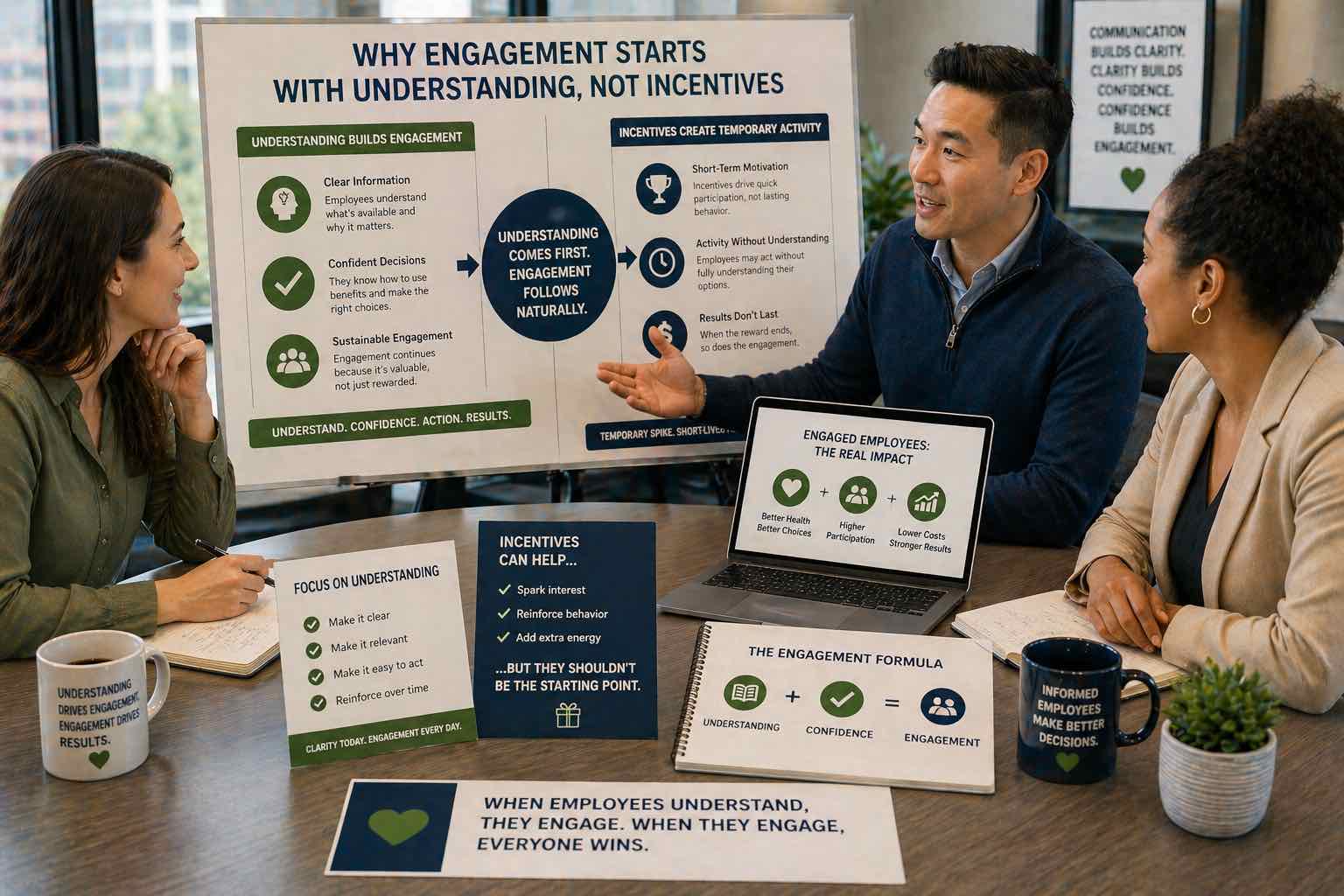
When organizations look to improve employee engagement, the first instinct is often to add incentives—gift cards, rewards programs, contests, or bonuses tied to participation.
While incentives can create short-term activity, they rarely create lasting engagement.
Why?
Because engagement doesn’t start with motivation—it starts with understanding.
At Touchpoints, we’ve seen that when employees truly understand their benefits, their options, and the impact of their decisions, engagement becomes natural and sustainable. Without that understanding, even the best incentives struggle to drive meaningful results.
The Incentive Trap
Incentives are appealing because they offer a quick solution.
- Want more participation? Offer a reward
- Want higher enrollment? Add a bonus
- Want engagement? Create a contest
But incentives often lead to:
- Temporary spikes in activity
- Participation without true understanding
- Behavior that stops when the reward disappears
This creates a cycle where organizations must continuously add new incentives just to maintain engagement.
Why Incentives Alone Fall Short
Incentives focus on why employees should act—but they don’t address how or what it means.
Without understanding:
- Employees may participate once but not continue
- Decisions may still be inefficient or costly
- Confidence remains low
- Long-term behavior doesn’t change
Engagement built on incentives is fragile. Engagement built on understanding is durable.
The Foundation of Engagement: Understanding
Before employees can engage, they need clarity.
They need to know:
- What’s available to them
- How it works
- Why it matters to their lives
- What steps to take
When these questions are answered, engagement becomes a natural outcome—not something that needs to be forced.
What Happens When Employees Understand
When understanding is present, behavior changes.
Employees:
- Use benefits more effectively
- Make smarter healthcare and financial decisions
- Participate consistently in programs
- Feel more confident and supported
Engagement shifts from external motivation to internal confidence.
The Role of Communication in Building Understanding
Understanding doesn’t happen automatically—it’s built through communication.
Strategic communication helps employees:
- See what’s available (awareness)
- Learn how it works (education)
- Take action easily (access)
Without communication, understanding remains limited—and engagement suffers.
How to Build Engagement Through Understanding
To move beyond incentives, organizations need a communication strategy that prioritizes clarity and usability.
Start with Clarity
Make information easy to understand.
- Use plain, simple language
- Avoid jargon and technical terms
- Focus on what employees need to know right now
Clarity removes hesitation and builds confidence.
Make It Relevant
Connect benefits and programs to real-life situations.
- Use examples employees can relate to
- Highlight how resources solve everyday challenges
- Tailor messaging to different audiences
Relevance increases attention and interest.
Provide Clear Next Steps
Understanding must lead to action.
- Tell employees exactly what to do
- Provide direct links and instructions
- Remove unnecessary complexity
The easier it is to act, the more likely employees will engage.
Reinforce Over Time
Understanding deepens through repetition.
- Communicate year-round, not just during key events
- Reinforce important concepts consistently
- Align messaging with key decision moments
Repetition ensures information is retained and applied.
Where Incentives Fit In
This doesn’t mean incentives have no role.
When used effectively, incentives can:
- Encourage initial participation
- Reinforce positive behaviors
- Add energy to communication campaigns
But they should support understanding—not replace it.
When employees understand first, incentives become a boost—not a crutch.
The Impact of Understanding-Driven Engagement
When engagement is built on understanding, the results are stronger and more sustainable.
- Higher and more consistent participation
- Better decision-making by employees
- Improved utilization of benefits and resources
- Reduced costs through smarter behaviors
- Greater employee confidence and satisfaction
Engagement becomes meaningful—not just measurable.
From Motivation to Confidence
The goal of communication isn’t to push employees to act—it’s to help them feel confident enough to act on their own.
Confidence comes from:
- Clear information
- Relevant guidance
- Easy access to resources
When employees feel confident, engagement follows naturally.
Your Path Forward
If your engagement efforts rely heavily on incentives, it may be time to shift your approach.
At Touchpoints, we help organizations build communication strategies that prioritize understanding—ensuring employees know what’s available, how it works, and how to use it effectively.
Conclusion
Incentives may spark attention, but understanding sustains engagement.
When employees clearly understand their options and feel confident in their decisions, they don’t need to be pushed—they choose to participate.
Because in the end, true engagement isn’t driven by rewards—it’s driven by clarity, confidence, and the ability to take meaningful action.