
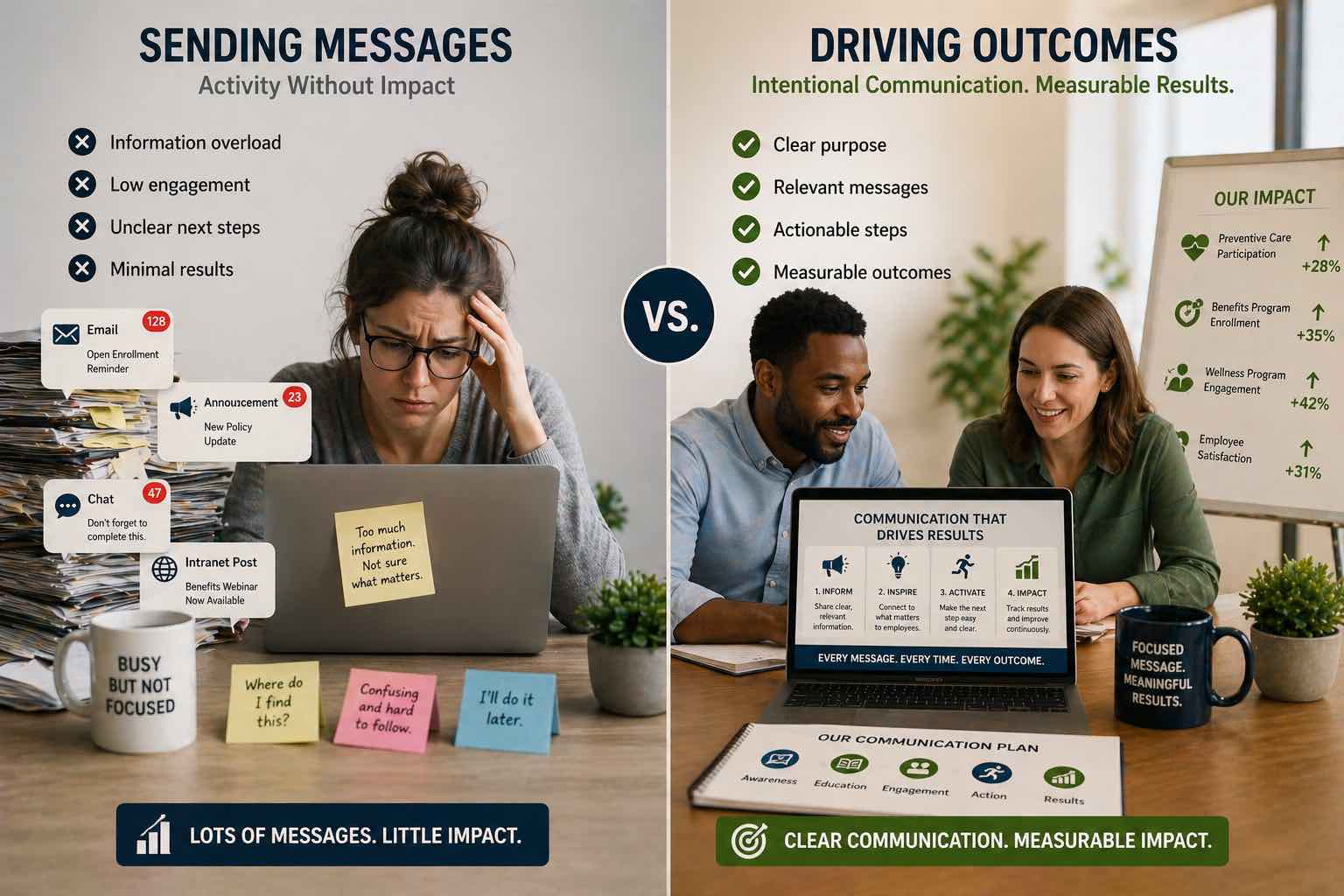
Most organizations are busy communicating.
Emails go out. Announcements are posted. Updates are shared across platforms. From the outside, it looks like communication is happening at a high level.
But there’s a critical question many organizations don’t stop to ask:
Is communication actually driving results?
At Touchpoints, we’ve seen a clear distinction between organizations that simply send messages—and those that use communication to drive outcomes. The difference isn’t volume. It’s intention.
The Illusion of Communication
It’s easy to assume that once a message is sent, the job is done.
- The email was delivered
- The announcement was posted
- The information is “out there”
But sending a message doesn’t guarantee:
- It was seen
- It was understood
- It was remembered
- It led to action
Communication without outcomes is just activity.
Why Messages Don’t Always Lead to Results
Many organizations fall into a pattern of reactive communication—sharing information as it becomes available without a clear strategy behind it.
This often leads to:
- Information overload with no clear priority
- Low engagement because messages feel irrelevant
- Missed actions because next steps aren’t clear
- Inconsistent understanding across teams
Without a defined goal, communication becomes noise.
The Shift: From Activity to Impact
To move from sending messages to driving outcomes, organizations need to change how they think about communication.
Instead of asking:
- “Did we send it?”
Ask:
- “Did it create the result we wanted?”
This shift transforms communication into a strategic tool.
What Outcome-Driven Communication Looks Like
Outcome-driven communication starts with a clear objective.
Every message is designed to:
- Influence a specific behavior
- Support a defined goal
- Lead to a measurable result
Examples include:
- Increasing preventive care participation
- Driving enrollment in a benefits program
- Improving compliance with a policy
- Encouraging use of a specific resource
The message is not the goal—the outcome is.
The Building Blocks of Outcome-Driven Communication
To drive results, communication must be intentional and structured.
1. Start With the Desired Action
Before creating a message, define what you want employees to do.
- Schedule a screening
- Enroll in a program
- Use a specific tool
- Follow a process
Clarity of action leads to clarity of communication.
2. Make the Message Clear
Employees should immediately understand what’s being communicated.
- Use simple, direct language
- Focus on key points
- Avoid unnecessary detail
Clarity removes barriers to action.
3. Connect to Relevance
Employees are more likely to act when the message feels meaningful.
- Explain why it matters
- Connect to real-life situations
- Highlight personal impact
Relevance drives engagement.
4. Provide a Clear Path to Action
Even motivated employees may not act if the process is unclear.
- Include direct links
- Provide step-by-step guidance
- Remove unnecessary friction
Ease of action increases follow-through.
5. Reinforce Over Time
One message rarely leads to behavior change.
- Repeat key messages
- Use multiple channels
- Align communication with key moments
Repetition ensures the message sticks.
Measuring What Matters
Outcome-driven communication focuses on results—not just activity.
Instead of tracking:
- Number of emails sent
Focus on:
- Participation rates
- Engagement levels
- Behavior changes
- Cost or efficiency improvements
Measurement shifts the focus from output to impact.
The Impact of Outcome-Driven Communication
When communication is designed to drive outcomes, the benefits are clear:
- Higher engagement across programs and initiatives
- Improved decision-making by employees
- Better utilization of benefits and resources
- Reduced costs through smarter behaviors
- Stronger alignment with organizational goals
Communication becomes a driver of performance—not just a support function.
From Messages to Meaningful Results
Most organizations already have the tools and channels they need.
The opportunity lies in how communication is designed.
By focusing on:
- Clear objectives
- Relevant messaging
- Consistent reinforcement
- Actionable guidance
Organizations can turn everyday communication into measurable results.
Your Path Forward
If your communication efforts feel busy but not impactful, it may be time to rethink your approach.
At Touchpoints, we help organizations move beyond message delivery and build strategies that drive real outcomes—ensuring every communication has a purpose and a measurable impact.
Conclusion
Sending messages is easy. Driving outcomes requires intention.
When communication is designed with a clear goal, delivered with clarity, and reinforced over time, it becomes a powerful tool for influencing behavior and achieving results.
Because in the end, success isn’t measured by what you send—it’s measured by what changes because of it.