
When healthcare costs rise, many organizations face a difficult question:
How do we control spending without hurting the business?
Too often, the default answer is to cut benefits, increase employee contributions, or reduce coverage. While these actions may provide short-term relief, they rarely solve the underlying problem—and in many cases, they create new ones.
At Touchpoints, we’ve seen that reducing benefits doesn’t reduce costs in a meaningful, sustainable way. Instead, it often shifts the burden, lowers engagement, and weakens the very programs designed to support employees and the organization.
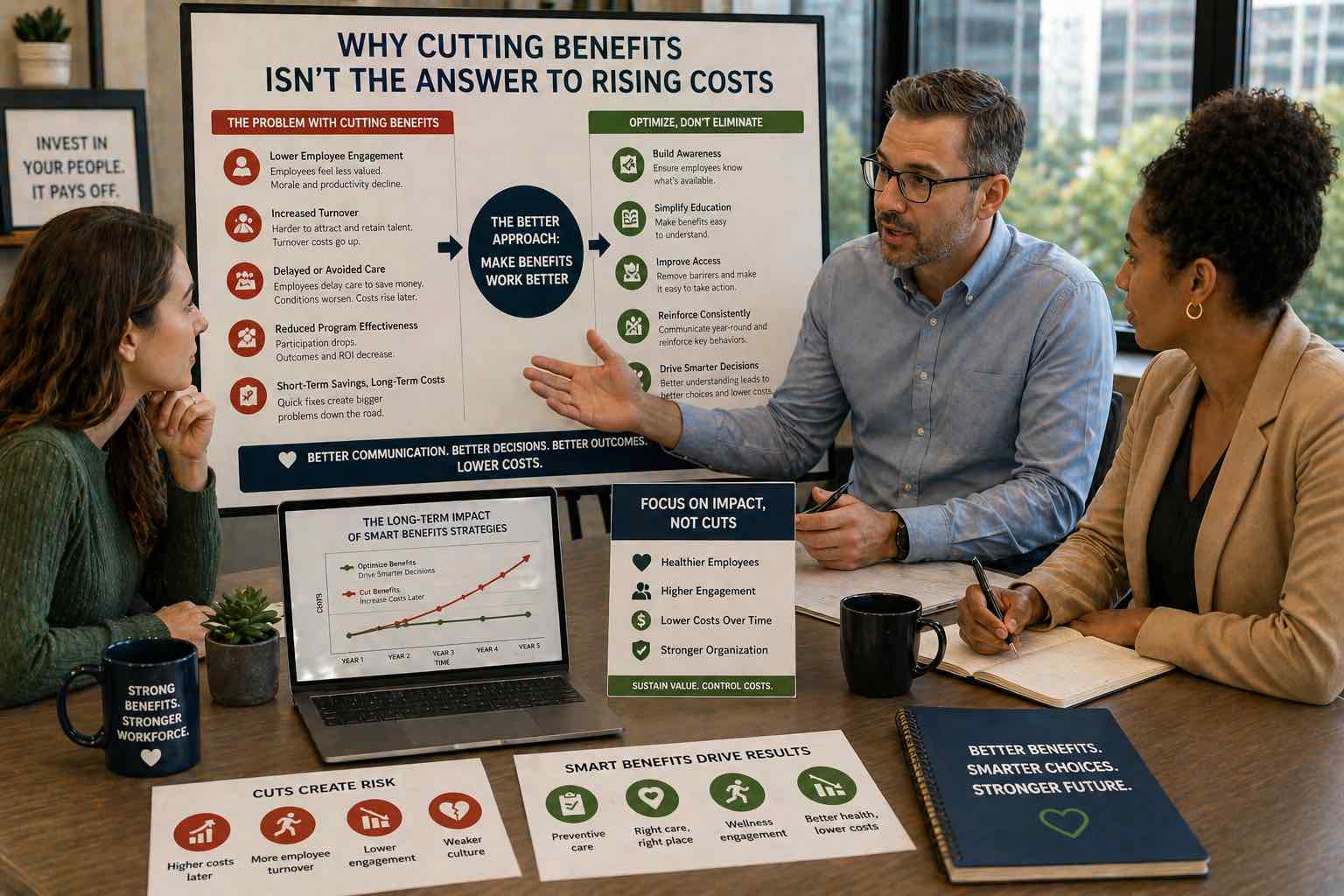
The better approach isn’t to offer less—it’s to make what you offer work better.
The Short-Term Thinking Trap
Cutting benefits can feel like a quick fix.
- Reduce coverage → lower immediate costs
- Increase premiums → shift expenses to employees
- Eliminate programs → simplify the budget
But these actions focus on symptoms, not causes.
They don’t address why costs are rising in the first place. And over time, they often lead to unintended consequences that outweigh the initial savings.
The Hidden Costs of Cutting Benefits
Reducing benefits may lower expenses on paper—but it introduces new risks and costs across the organization.
Lower Employee Engagement
Benefits are a key part of how employees perceive their overall compensation and support.
When benefits are reduced:
- Employees feel less valued
- Trust in the organization declines
- Engagement and morale decrease
Disengagement leads to lower productivity and weaker performance.
Increased Turnover
Competitive benefits play a major role in attracting and retaining talent.
When benefits are cut:
- Employees are more likely to explore other opportunities
- Recruitment becomes more difficult
- Turnover costs increase
Replacing employees is often more expensive than maintaining strong benefits.
Delayed or Avoided Care
When costs are shifted to employees, many respond by delaying or avoiding care.
- Preventive services are skipped
- Conditions worsen over time
- Treatment becomes more complex and expensive
What saves money in the short term can drive higher claims in the long term.
Reduced Program Effectiveness
Wellness programs and support resources depend on participation.
When benefits are scaled back or engagement declines:
- Participation drops
- Outcomes weaken
- The return on investment diminishes
Programs lose their ability to deliver value.
The Real Driver of Rising Costs
Healthcare costs don’t rise simply because benefits are too generous.
They rise because of how benefits are used.
Common drivers include:
- Low utilization of preventive care
- Overuse of high-cost services
- Confusion around plan options
- Limited engagement in wellness programs
These are behavioral challenges—not structural ones.
And behavior can be influenced.
The Better Approach: Optimize, Don’t Eliminate
Instead of cutting benefits, organizations should focus on improving how those benefits are understood and used.
When employees are informed and engaged, they:
- Make smarter healthcare decisions
- Use cost-effective services
- Take advantage of preventive care
- Participate in wellness initiatives
This approach addresses the root cause of rising costs.
The Role of Communication in Cost Control
If behavior is the driver, communication is the solution.
Strategic communication helps employees:
- Understand their benefits clearly
- Recognize cost-saving opportunities
- Take action at the right time
This transforms benefits from a passive offering into an active tool for cost management.
How to Make Benefits Work Better
To control costs without cutting value, organizations need a structured communication strategy.
Build Awareness
Ensure employees know what benefits are available.
- Highlight preventive services
- Promote lower-cost care options
- Increase visibility of wellness programs
Simplify Education
Make benefits easy to understand.
- Use plain language
- Provide real-life examples
- Focus on practical guidance
Improve Access
Remove barriers to action.
- Provide direct links and clear instructions
- Ensure mobile-friendly access
- Make resources easy to find and use
Reinforce Consistently
Behavior change requires repetition.
- Communicate year-round
- Align messages with key decision moments
- Reinforce important behaviors over time
The Impact of Optimization
When benefits are optimized through communication, the results are measurable:
- Increased preventive care usage
- Reduced reliance on high-cost services
- Improved employee health outcomes
- Higher engagement and retention
- Lower overall healthcare costs
Instead of reducing value, organizations unlock it.
From Cost Cutting to Cost Control
There’s a difference between cutting costs and controlling them.
- Cutting costs reduces investment—but often creates new risks
- Controlling costs improves efficiency and outcomes over time
The most successful organizations focus on control, not reduction.
Your Path Forward
If rising costs are putting pressure on your organization, resist the urge to cut benefits as a first step.
Instead, look at how your benefits are being used—and how communication can improve that usage.
At Touchpoints, we help organizations design communication strategies that drive smarter decisions, better engagement, and long-term cost control.
Conclusion
Cutting benefits may seem like a solution—but it rarely addresses the real problem.
When employees don’t understand or use their benefits effectively, costs rise—regardless of what’s offered.
The answer isn’t less. It’s better.
Better communication. Better understanding. Better decisions.
Because in the end, controlling costs isn’t about what you take away—it’s about how well your workforce uses what you provide.