
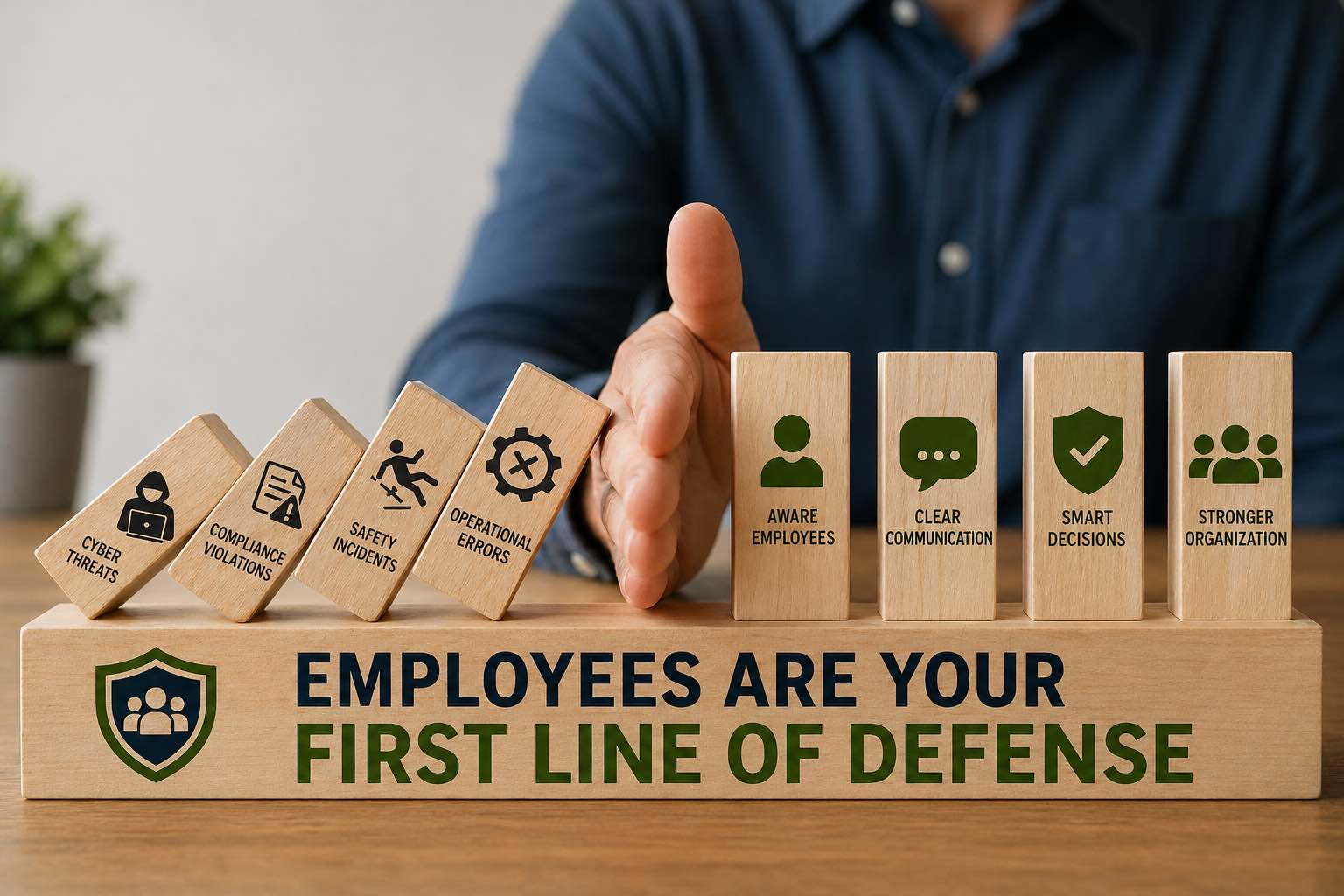
When organizations think about risk management, they often focus on systems, policies, and technology.
Firewalls are installed. Procedures are documented. Compliance frameworks are built.
All of these are important—but they share one common dependency:
People.
At Touchpoints, we’ve seen that no matter how strong your systems are, your employees are the ones interacting with them every day. Their decisions, awareness, and actions determine whether risks are avoided—or realized.
That’s why employees aren’t just part of your risk strategy.
They are your first line of defense.
The Reality of Organizational Risk
Modern organizations face a wide range of risks:
- Cybersecurity threats like phishing and data breaches
- Compliance violations due to misunderstood policies
- Workplace safety incidents caused by lack of awareness
- Operational errors stemming from unclear processes
While these risks vary, they often share a common root cause:
👉 A breakdown in understanding or communication.
Most risks don’t happen because systems fail—they happen because people don’t have the information they need at the right time.
Why Employees Play a Critical Role
Every day, employees make decisions that either reduce risk—or increase it.
They:
- Open emails and decide whether they’re legitimate
- Follow (or misunderstand) compliance procedures
- Take actions that impact workplace safety
- Handle sensitive information
These decisions are often made quickly, in real time.
Without the right knowledge and guidance, even well-intentioned employees can make costly mistakes.
The Gap Between Policy and Practice
Organizations invest heavily in creating policies and procedures. But there’s often a gap between what’s documented and what’s actually followed.
This gap appears when:
- Policies are difficult to understand
- Training is delivered once and not reinforced
- Communication is inconsistent or unclear
- Employees don’t see how policies apply to their daily work
When this happens, risk increases—not because policies are weak, but because they’re not fully understood or applied.
The Role of Communication in Risk Management
If employees are the first line of defense, communication is what equips them.
Strategic communication ensures employees:
- Understand potential risks
- Recognize warning signs
- Know how to respond appropriately
- Take preventive action
Without communication, even the best policies remain unused.
Building a Risk-Aware Workforce
To strengthen your first line of defense, communication must be clear, consistent, and actionable.
Make Risk Understandable
Complex policies don’t protect organizations—clear understanding does.
- Use simple, direct language
- Focus on real-world scenarios
- Highlight what employees need to watch for
When employees understand risk, they can recognize it.
Reinforce Through Consistency
One-time training isn’t enough.
- Provide ongoing reminders
- Reinforce key behaviors regularly
- Use multiple channels to increase visibility
Repetition ensures awareness stays high.
Deliver at the Right Time
Timing is critical in risk communication.
- Share information when it’s most relevant
- Provide reminders before high-risk activities
- Respond quickly to emerging threats
Timely communication enables immediate action.
Make Action Clear
Employees need to know exactly what to do.
- Provide step-by-step guidance
- Offer clear reporting processes
- Remove uncertainty around next steps
Clarity turns awareness into action.
The Impact of Empowered Employees
When employees are informed and prepared, the benefits are significant:
- Reduced security breaches and compliance issues
- Fewer workplace incidents and errors
- Faster response to emerging risks
- Stronger organizational resilience
- Increased confidence across teams
Employees shift from being potential vulnerabilities to active protectors of the organization.
From Reactive to Proactive Risk Management
Many organizations take a reactive approach—responding to incidents after they occur.
But when employees are equipped through communication, organizations can move to a proactive model:
- Identifying risks early
- Preventing issues before they escalate
- Reducing the frequency and severity of incidents
Prevention becomes possible when awareness is high.
Your Path Forward
If risk management efforts aren’t delivering the results you expect, consider where communication fits into your strategy.
At Touchpoints, we help organizations build communication systems that empower employees with the knowledge and confidence they need to identify and prevent risks—turning your workforce into your strongest line of defense.
Conclusion
Risk management isn’t just about systems—it’s about people.
When employees understand what to look for, why it matters, and how to respond, they become a powerful force for prevention.
Because in the end, the strongest defense against risk isn’t just what you build—it’s what your people know and do every day.